
Jensen Huang’s NVIDIA Exit: What It Means for AI Students
Introduction
For more than three decades, Jensen Huang was not simply the chief executive of NVIDIA. He was the company’s founder, strategist, storyteller, and public face. When he walked onto a keynote stage in his familiar black leather jacket, he was not only introducing a product. He was explaining a future he believed NVIDIA was building.
That is why his resignation feels larger than an ordinary leadership change.
On November 12, 2026, NVIDIA announced that Huang had resigned as president, chief executive officer, and board member, effective immediately. Chief Financial Officer Colette Kress became interim CEO while continuing as CFO, and Harvey C. Jones was appointed the company’s first chair of the board. The board began a search for a permanent chief executive and said it would consider both internal and external candidates. These details are confirmed by NVIDIA’s official transition announcement.
For students, the headline should not be reduced to gossip. Huang’s life story carries real lessons about immigration, engineering, persistence, platform building, and the extraordinary scale of modern AI. His exit also carries a second set of lessons about accountability, board governance, workplace boundaries, national security, and the difference between a confirmed fact and a reported allegation.
Both stories matter. A serious look at Huang’s career should recognize what he helped build without ignoring the controversy that brought his leadership to an end.
From Tainan to the United States
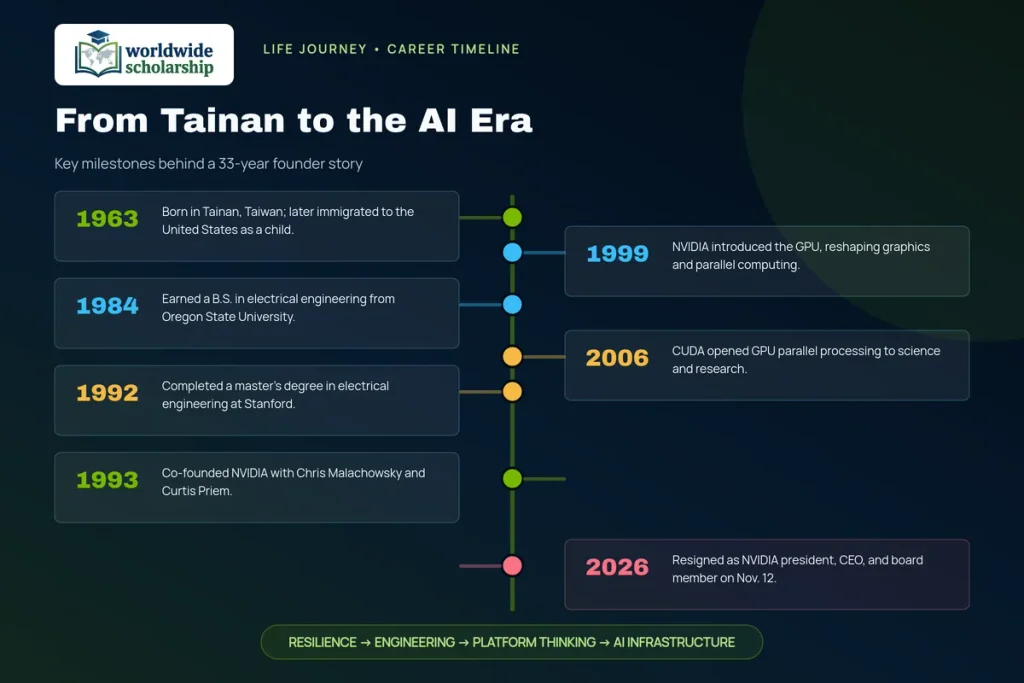
Jensen Huang was born in Tainan, Taiwan, in 1963. His path to the center of the technology industry was not smooth or privileged. As a child, he immigrated to the United States with his older brother. According to Oregon State University’s alumni biography, the brothers were inadvertently placed in a reform school in rural Kentucky. Huang later described the experience as a “hard knocks” introduction to American life.
He eventually rejoined his family in Oregon, attended high school in Beaverton, and became a nationally ranked junior table-tennis player. Those details matter because they show that Huang’s later confidence was not inherited from an easy childhood. It was shaped through adaptation, competition, and the discipline of starting again in an unfamiliar place.
At Oregon State University, Huang studied electrical engineering. His lab partner was Lori Mills, who later became his wife. After earning his bachelor’s degree in 1984, he worked in the semiconductor industry and continued his education while working full time. He completed a master’s degree in electrical engineering at Stanford University in 1992. Before co-founding NVIDIA, he worked at Advanced Micro Devices and LSI Logic.
For international students, this part of the story is especially powerful. Huang did not arrive with a perfect network or an effortless route into Silicon Valley. He built his future through technical education, practical experience, and years of sustained work.
The Founder Who Saw a Platform Before the Market Did
In 1993, Huang co-founded NVIDIA with Chris Malachowsky and Curtis Priem. At the time, the company was focused on graphics processors for gaming and multimedia. It was an important market, but it was not yet clear that NVIDIA would become one of the central companies of the AI era.
The first major breakthrough came in 1999, when NVIDIA introduced the GPU, or graphics processing unit. NVIDIA’s corporate timeline describes the GPU as a technology that reshaped the computing industry. GPUs were designed to handle many visual calculations in parallel, making them far more efficient than traditional processors for graphics-heavy work.
The deeper insight came later. Huang and his team recognized that the same parallel-processing architecture could be used for problems far beyond gaming. In 2006, NVIDIA introduced CUDA, a platform that allowed developers and researchers to program GPUs for general-purpose computing. That decision helped transform NVIDIA from a graphics-hardware company into an accelerated-computing platform.
The modern AI connection became unmistakable in 2012, when NVIDIA GPUs powered the breakthrough AlexNet neural network. NVIDIA identifies AlexNet as the moment that helped ignite the modern AI era. As deep-learning models grew larger and more demanding, the industry needed exactly the kind of parallel computing infrastructure NVIDIA had spent years building.
Huang’s achievement was therefore not only the creation of a successful chip company. It was the patient construction of an ecosystem. NVIDIA combined processors, systems, networking, software libraries, developer tools, and industry platforms. By the time generative AI became a global priority, NVIDIA was already positioned at the center of the compute supply chain.
Achievements That Changed the AI Industry
Huang’s career is closely connected to the rise of accelerated computing. Under his leadership, NVIDIA moved from graphics cards to data centers, scientific research, robotics, autonomous systems, healthcare, digital twins, and generative AI.
The company’s influence can be seen in the language of modern AI. Discussions about training large models now routinely involve GPU clusters, memory bandwidth, interconnects, inference performance, data-center capacity, and energy efficiency. These are not abstract technical details. They determine how quickly new AI systems can be trained, how expensive they are to operate, and which organizations can afford to build them.
Huang also became one of technology’s most recognizable executives. His keynotes combined product launches with a broader argument about the future of computing. He spoke about AI not as a single application but as a new industrial layer that would reshape science, transportation, medicine, manufacturing, entertainment, and education.
In April 2026, IEEE formally presented Huang with the IEEE Medal of Honor for leadership in developing GPUs and applying them to scientific computing and artificial intelligence. IEEE’s award page describes the medal as the organization’s highest distinction. IEEE’s recipient profile also notes that Huang served as NVIDIA’s president, CEO, and board member from the company’s founding in 1993 until his resignation in 2026.
That recognition captures the scale of his technical legacy. Whatever conclusion readers ultimately draw about his departure, Huang’s role in building the infrastructure behind modern AI is historically significant.
The November 2026 Controversy
Huang’s resignation followed a rapid sequence of reports, an internal investigation, a personal apology, and a formal leadership transition. Because the claims are serious, they need to be handled carefully.
The board opened an independent investigation
On November 8, NVIDIA announced that its board was initiating an independent investigation following media reporting that Huang had been the target of a foreign-intelligence effort. A committee of independent directors, assisted by outside counsel, was assigned to oversee the review.
The board’s statement included an important balance: it said there was “no reason to believe” that either national security or NVIDIA secrets had been compromised. Huang supported the review and committed to cooperating with it. These points come from NVIDIA’s official board statement.
That distinction is essential. An investigation is a process, not a verdict. It does not prove that secrets were shared, that a security breach occurred, or that Huang knowingly helped a foreign intelligence service. As of November 13, no public investigative finding has established those claims.
Huang admitted infidelity
Also on November 8, Huang sent a message to NVIDIA employees acknowledging that he had been unfaithful to his wife. He wrote that his actions had hurt his wife and children, that there was no excuse for what he did, and that he was deeply sorry. He also said he supported the board’s investigation and would cooperate fully. NVIDIA published the message in its newsroom.
This confirms that Huang admitted infidelity. It does not independently confirm every additional detail reported by media outlets about another person’s identity, role, or conduct.
China rejected the allegation
China’s Ministry of Foreign Affairs rejected the claim that a Chinese national connected to the story was a “Chinese spy.” At a November 9 press briefing, spokesperson Guo Jiakun called the allegation “purely unsubstantiated and directed at smearing China.” The official transcript is available from China’s Ministry of Foreign Affairs. The ministry repeated its denial when asked follow-up questions on November 10. The November 10 transcript records that response.
A government denial should be reported, but it should not be treated as the final word. The fair summary is that U.S. intelligence suspicions were reported in the media, NVIDIA opened an independent investigation, China denied the allegation, and the public record had not produced a final investigative finding as of November 13.
The workplace-relationship report
On November 11, The New York Times reported that Huang had an extramarital relationship with Kimberly Powell, NVIDIA’s vice president of healthcare, who reportedly reported directly to him. CBS News included the report in its timeline of the events leading to Huang’s resignation. CBS News’ summary separates that media report from NVIDIA’s official announcement the following day.
As of November 13, the specific allegation involving Powell should remain attributed to The New York Times unless Powell, Huang, NVIDIA, or an official investigation confirms it. If accurate, a relationship between a chief executive and a direct report would raise serious conflict-of-interest and workplace-governance concerns. But an allegation is not the same as an established policy violation.
The resignation
NVIDIA announced Huang’s resignation on November 12. The official release did not assign a single cause. It confirmed that Huang had resigned from all three roles—president, CEO, and board member—and that the transition was effective immediately. NVIDIA’s announcement also said the company expected operations, customer commitments, and the product roadmap to continue without interruption.
It is reasonable to say that the resignation followed several days of scrutiny. It is not reasonable to claim that NVIDIA officially blamed one specific allegation unless the company or investigators say so.
Why the Exit Matters for NVIDIA
Huang’s departure matters because he was more than a manager. He was a founder whose technical instincts and public messaging shaped NVIDIA’s identity. Founders often carry a company’s history in their minds. They remember why decisions were made, which risks were accepted, and which long-term bets failed before they succeeded.
Replacing that kind of leader is difficult. NVIDIA’s next permanent CEO will need to preserve the company’s engineering culture while strengthening confidence among employees, customers, regulators, investors, and governments. The board will also need to show that oversight is not merely symbolic.
At the same time, NVIDIA is not one person. Its products are created by thousands of engineers, researchers, designers, operations specialists, and business teams. Its roadmap depends on a global ecosystem of suppliers, manufacturers, cloud providers, universities, software developers, and enterprise customers.
Colette Kress’s appointment as interim CEO gives the company continuity in finance and operations. Harvey C. Jones’s appointment as board chair creates a clearer separation between board oversight and executive management. The long-term effect will depend on the quality of the investigation, the transparency of the transition, and the leadership of the permanent CEO.
What AI Students Should Learn From This Moment
The easiest response to a technology scandal is to focus on personalities. The more useful response is to ask what the moment reveals about the future of AI work.
AI careers are bigger than one company
NVIDIA is central to accelerated computing, but the AI workforce extends far beyond one company. Students can build careers in chip design, cloud infrastructure, robotics, healthcare AI, cybersecurity, data engineering, policy, product management, education, and research. A leadership change at one company does not remove the global need for AI talent.
Infrastructure knowledge will become more valuable
Modern AI is not only about writing prompts or using a chatbot. It depends on GPUs, networking, memory, data centers, energy, distributed systems, and model-serving infrastructure. Students who understand both machine learning and the systems beneath it will be better prepared for advanced roles.
Governance is now part of technical work
The November 2026 controversy shows why AI professionals need more than coding skills. Boards, export controls, privacy rules, national-security concerns, workplace policies, and public trust all influence how AI is built and deployed. Students who can understand technical systems and communicate responsibly about risk will have an advantage.
Personal judgment shapes institutional trust
Huang’s career shows how vision and persistence can build a company. His exit shows how personal decisions can affect an entire institution. For students, the lesson is direct: talent can open doors, but trust determines whether those doors remain open.
Build evidence, not just a résumé
AI students should create visible proof of their abilities. A strong portfolio may include GitHub projects, reproducible machine-learning experiments, technical writing, research posters, internships, open-source contributions, and clear explanations of design choices. Employers and scholarship committees want evidence that a student can finish difficult work and explain it honestly.
A Practical Roadmap for Students
Students who want to respond constructively can begin with a simple three-stage plan.
During the first month, strengthen the foundation. Review linear algebra, probability, statistics, and optimization. Practice Python and learn how computer systems handle memory, processing, and data. Build one small machine-learning project from data collection through evaluation.
During the second month, move closer to infrastructure. Learn how GPUs accelerate matrix operations. Study the difference between training and inference, latency and throughput, and model size and deployment cost. Try profiling a simple model and documenting what improves performance.
During the third month, add governance and communication. Write a model card or project report that explains the data, limitations, risks, and ethical considerations. Practice presenting technical work in plain English. Learn the basics of privacy, AI safety, export controls, and conflict-of-interest policies.
This approach does not copy Huang’s career. It adapts the strongest parts of his example—technical depth, patience, and platform thinking—while taking seriously the governance lessons raised by his exit.
Frequently Asked Questions
Did Jensen Huang resign from NVIDIA?
Yes. NVIDIA announced on November 12, 2026, that Huang resigned as president, chief executive officer, and board member, effective immediately.
Who replaced Jensen Huang as CEO?
Colette Kress became interim CEO while continuing as executive vice president and CFO. NVIDIA’s board is searching for a permanent CEO and says it will consider internal and external candidates.
Why did Jensen Huang resign?
NVIDIA’s official announcement did not identify a specific reason. The resignation followed an independent board investigation, Huang’s public apology for infidelity, and media reporting about workplace conduct and national-security concerns. The timing is confirmed, but readers should not claim an official cause that NVIDIA has not stated.
Was NVIDIA’s technology compromised?
NVIDIA’s board said it had no reason to believe that national security or NVIDIA secrets were compromised. The board still opened an independent investigation. As of November 13, there was no public finding establishing that NVIDIA secrets were compromised.
Is the Kimberly Powell allegation confirmed?
The New York Times reported on November 11 that Huang had an extramarital relationship with NVIDIA healthcare executive Kimberly Powell. As of November 13, that specific claim should remain attributed to the report unless confirmed by the individuals, NVIDIA, or an official investigation.
Did China accept the espionage allegation?
No. China’s Ministry of Foreign Affairs rejected the allegation and called it unsubstantiated. The denial should be included for balance, but readers should distinguish between a government denial, a media allegation, and a completed investigation.
Should students avoid AI careers because of this controversy?
No. The controversy highlights the need for responsible AI professionals, not the disappearance of AI opportunities. Students should prepare for a field that requires technical excellence, security awareness, ethical judgment, and clear communication.
Are the portraits in this article real photographs?
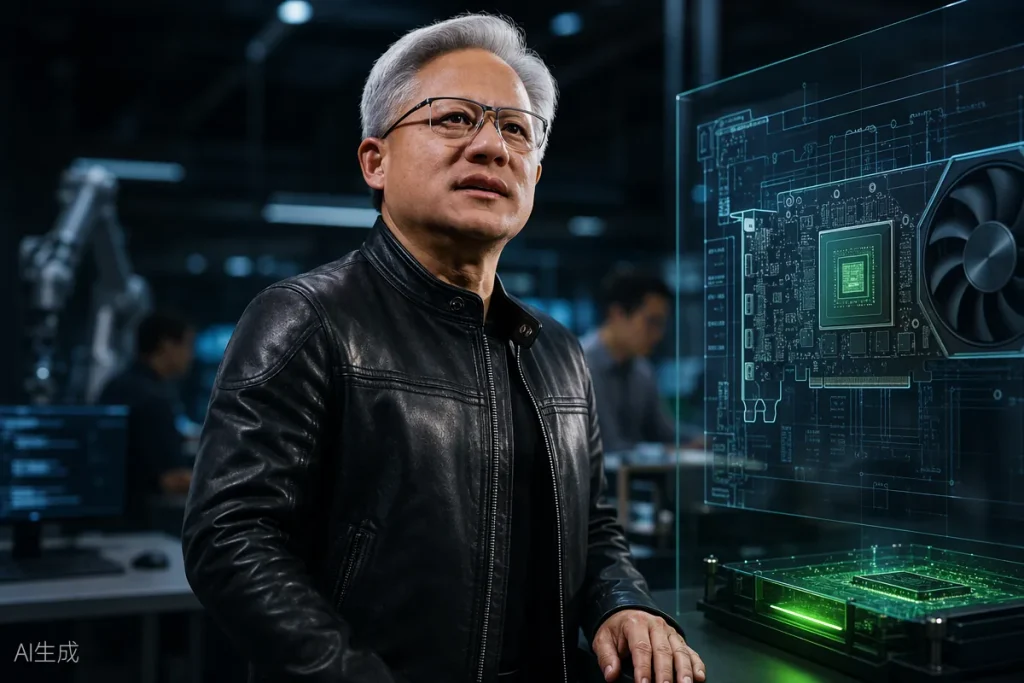
No. The three portraits in this article are AI-generated editorial illustrations based on Jensen Huang’s public appearance. They are included as visual interpretations and should not be described or republished as real photographs.
Conclusion
Jensen Huang’s story contains two truths that should not be separated.
The first is that he helped build one of the defining technology platforms of the AI era. His journey from an immigrant student to electrical engineer, NVIDIA co-founder, and IEEE Medal of Honor recipient is a remarkable example of persistence, technical conviction, and long-term vision.
The second is that no leader is larger than an institution. The November 2026 controversy and resignation show why independent boards, workplace rules, transparent communication, and personal accountability matter. AI is no longer a niche technology. It is critical infrastructure, and the people who lead it will face real-world scrutiny.
For students, the lesson is not to choose between admiration and criticism. It is to learn from both. Study the technology. Understand the infrastructure. Build a portfolio. Respect the responsibility. And remember that in AI, trust is becoming as important as talent.
Source Notes
- NVIDIA: NVIDIA Announces CEO Transition — resignation, interim CEO, board chair, and succession search.
- NVIDIA: Statement From the Board of Directors — independent investigation and statement that the board had no reason to believe secrets or national security were compromised.
- NVIDIA: A Message to Our Company — Huang’s apology and commitment to cooperate.
- China Ministry of Foreign Affairs: November 9, 2026 Press Conference — official Chinese denial.
- China Ministry of Foreign Affairs: November 10, 2026 Press Conference — follow-up denial.
- Oregon State University: Jen-Hsun Huang Engineering Hall of Fame — early life, education, and pre-NVIDIA career.
- NVIDIA: Corporate Timeline — founding, GPU, CUDA, and AlexNet milestones.
- IEEE: Jensen Huang Recipient Profile — career summary and recognition.
- IEEE: Medal of Honor — 2026 award and citation.
- CBS News: Timeline of Jensen Huang’s Resignation — attributed summary of the Kimberly Powell report and resignation timeline.